Jon Nödtveidt: Από το «The Somberlain» στον αντικοσμικό σατανισμό — η ιστορία των Dissection | Metal Territory
29/09/2026
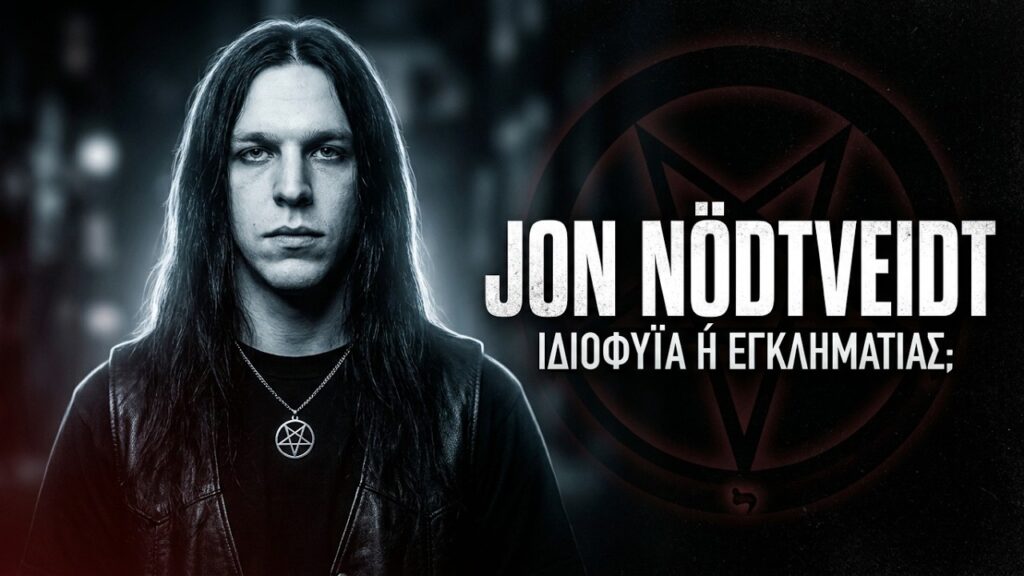
Jon Nödtveidt created one of the most recognizable sounds of Swedish black metal and lived a life that is still discussed to this day. He was the guitarist and singer of Dissection, the man behind the melancholic melodies of “The Somberlain” and “Storm of the Light’s Bane” — and at the same time a member of a satanic organization, convicted for involvement in a murder.
The early years
He was born on June 28, 1975 in Strömstad, a small coastal place near the Norwegian border, and grew up with a younger brother and an older sister. He came to love music through his father, who listened to rock and played guitar: at the age of four he asked him to teach him, and from then on the two of them spent their afternoons playing, together with his brother Emil.
His parents describe him as a quiet and smiling child, who however, when stressed, would shut himself in his room and cry for hours. At 12, in 1987, he formed his first band, Thunder, with classmates and his brother, and they recorded two songs on which he played guitar and sang.
Dissection and “The Somberlain”
In 1989 he founded Dissection with Peter Palmdahl on bass and Ole Öhman on drums. At fifteen he interviewed David Vincent of Morbid Angel, and that same year the band released the demo “The Grief Prophecy” — a 180-degree turn compared to Thunder.
In April 1991 Dead of Mayhem took his own life, and a few days later Dissection played “Freezing Moon” in his memory at a show in Falkenberg. Then John Zwetsloot joined as second guitar and they recorded “Into Infinite Obscurity”, in 1,000 copies — exactly as many as Mayhem’s “Deathcrush”.
In March 1993 they recorded “The Somberlain”, which came out in December of the same year and was dedicated to Euronymous, the leader of the Norwegian circle who had been murdered a few months earlier. At that time Norwegian black metal was in the news for church burnings and murders, but Nödtveidt pulled elsewhere: instead of a frozen sound and fast tempos, he wrote guitars in two-part harmonies, neoclassical melodies and a mournful atmosphere.
Storm of the Light’s Bane
His style peaked in November 1995 with “Storm of the Light’s Bane”, which put Dissection on the global stage and showed Nödtveidt as one of the best composers of his generation. In the summer of 1995 Zwetsloot had stopped showing up to rehearsals and his place was taken by Johan Norman.
The circle and the murder
In the same period, Nödtveidt and Norman joined the Misanthropic Luciferian Order, the satanic organization now known as the Temple of the Black Light — a branch of the True Satanist Horde founded by Vlad, also known by dozens of other pseudonyms. Norman left a little later.
In 1997 Dissection toured Europe together with Cradle of Filth and Dimmu Borgir, on the “Gods of Darkness” tour. That year, in July 1997, a 16-year-old found in a park in Gothenburg the body of a 36-year-old immigrant from Algeria, who had been shot in the back and the head. For months the police had no culprit; eventually two members of the organization were convicted, Nödtveidt as an accomplice to the murder, and he spent years in prison.
Prison, Reinkaos and the end
He got out in 2004 and rebuilt the band. In April 2006 he released “Reinkaos”, an album that divided people because its sound was different from what had come before: the lyrics were based on Vlad’s “Liber Azerate”, a book of black magic about the eleven anti-cosmic gods, and on the organization’s anti-cosmic satanic ideology.
On August 13, 2006 he was found dead in his home, inside a large circle he had drawn on the floor with burnt-out candles around him. The police ruled the death a suicide — the only wound was a gunshot to the right temple. In the room were found farewell letters to his father and his partner and his will, while it is said that “Liber Azerate” was open in front of him. He was 31 years old.
The other members of the band said that in the last weeks they saw him happier and more focused than ever. His own position was that a satanist chooses for himself when he leaves and that death is the last orgasm of life — that is, he didn’t leave out of despair, but out of the sense that he had completed whatever he wanted.
As you can see, it is hard for anyone to keep a distance between the artist and his work. Nödtveidt left behind songs that accompany generations of listeners — and a story that shows how easily a child who loved music can take the wrong path.
See also
See also: 23 Greek Black Metal gems and NINTH REALM – Damnation’s Veil.