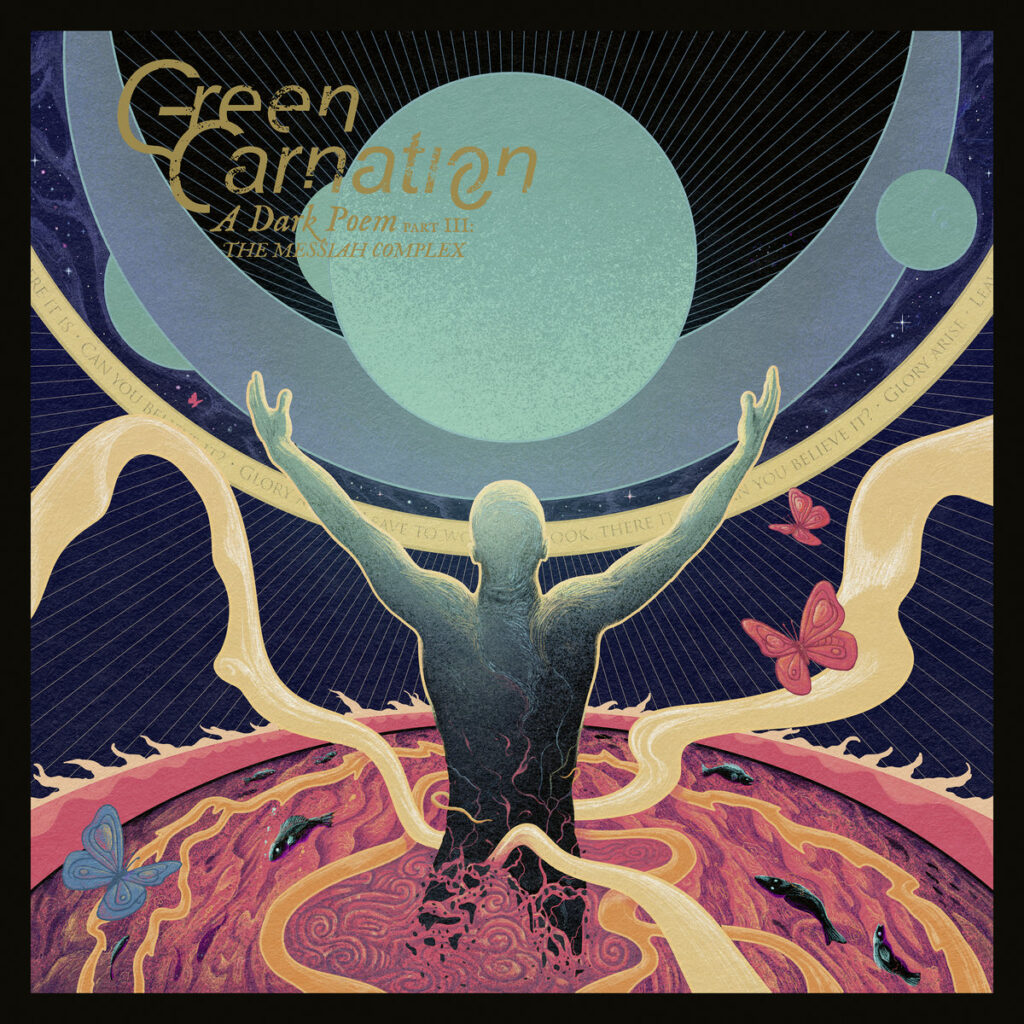
Green Carnation have closed the trilogy «A Dark Poem» with the third part, «The Messiah Complex», which was released on 4 September 2026 by Season of Mist. The cover art is signed by Niklas Sundin. The trilogy had been announced in August 2025, with three records within a year.
“`Country: Norway
Genre: Progressive metal (clean vocals)
For fans of: Opeth, Paradise Lost, Katatonia, Pain of Salvation
The record lasts thirty-eight minutes and has no room for unnecessary things. The four tracks are «Unconditional Artificial Chemistry», «The Messiah Complex» and «Broken Souls, Common Enemies», with «A Dark Poem – Orchestral Suite» lasting almost seventeen minutes and closing the record. Endre Kirkesola’s keyboards have a big role: they slip from airy melodies to theatrical, almost circus-like, church-organ passages.
The band knows how to raise the intensity step by step. On «The Messiah Complex» the key changes shift the ground under the listener’s feet, while on «Broken Souls, Common Enemies» Kjetil Nordhus puts a rough edge in his voice around the third minute. The solo of that track is not showing off, but a natural continuation of the melody. In the second half the flautist Ingrid Ose returns too, with calm exchanges with the guitar that are interrupted by spoken-word passages with distortion.
The lyrics move towards greater subtlety compared with earlier work. «The Messiah Complex» puts the questions about faith inside biblical images, while «Broken Souls, Common Enemies» looks inward and places the responsibility on the speaker himself too. There are still a few heavy turns of phrase, but the feeling is more mature.
In the closing, the orchestral suite is played by the Kristiansand Symphony Orchestra and Opera, with wordless choir and brass taking the lead. It is cinematic, but at the same time personal; even though the instruments change completely, the language of the music stays recognisable, like the same story from another narrator.
Our take
«The Messiah Complex» is the record that gives the trilogy meaning. On its own it is a good, elegant progressive metal album; together with the two previous ones, it places them in another light. Green Carnation’s strength is not that they write sad music, but that they find dozens of shades within that sadness without tiring you. The clean vocals and the orchestra at the end hold the listener until the last note. It is worth hearing the whole thing, in order.
See also
See also: SUBMASQ – Spirit Animal and Noveria – Becoming After.