“Loss of Transcendence” reflects an interest in two forms of thought that are not so obviously compatible: occult extreme metal and the bleak post-god-death reality merge into short and rousing odes of the enlightened. All of this is of course an important excuse to parade the interest in the always malleable forces of 80s extreme metal, where we find the band’s fusion in full harmony with the pre-idealist states of black, death and thrash metal, when each was flourishing closer to its roots and crossing over in wild, uninhibited ways.

The Great Observer formed around 2021 by guitarist/singer Daniele Z. (formerly of Night Gaunt) and drummer/singer Luca E. (formerly of Demonomancy), without a specific subgenre or idea in mind. They worked on their first ideas in the rehearsal room for at least a year or two. The style that developed in between draws from early extreme thrash like the early Mortuary Drape, Slaughter (Canada) and generally a late 80s thrashing black/death metal fusion.
After bassist Claudio S. (Vultures Vengeance) and guitarist Matteo A. were added in 2023, they started working on what would become “Loss of Transcendence”. Although they haven’t put out small releases in between, it’s fair to say that their resumes give a good picture of what their debut is: an extreme metal record with close ties to the dark and extreme side of heavy metal after the mid-80s.
Even though The Great Observer spend their time leafing through surreal 3-4 minute proto-death acts with an almost primitive form, their lyrics are far less direct than their riffs. We find the quartet’s lyrics thematically around Western philosophy, between ancient Greek complexity and 19th and 20th century interpretations of existentialism.
The way I interpret the theme of “Loss of Transcendence” comes from old thoughts on religion’s effect on Western society, from the earliest critiques of man’s ability to perceive the divine (or “the gods”) to Nietzschean observations, where the collapse of popular faith in Christianity signaled the destabilization of the moral foundations, the hierarchical structure and the overall identity of the Western world. This should at least “click” for those who have taken more than two or three philosophy courses at university, but it doesn’t fully show the band’s stance and perspective — in my estimation, this is a post-catastrophic image. Without the lyric sheet in hand, everything is speculation.
Of course, The Great Observer’s stance, with the 80s heavy metal push and boastful style, is apparent from the start. The opening and title track (“The Great Observer”) has moments of sonic inspiration and energy similar to the Greek band Eleventh Ray. A coherent thread is created between the percussive style of early extreme metal (in both cases, the Hellhammer to Celtic Frost transition) and pure thrash metal, with sonically blackened death metal vocals leading the attack.
This opener was placed first for a good reason, because the primitive slap of their work is presented through a track named after the band, which represents their main intention in plain words. The next/single “Sentenced at High Noon” (see also: “The Weight of Being Free”) reinforces this effect, recalling an amped-up version of death metal inspired by ‘To Mega Therion’ in the late 80s/early 90s, like Pentacle.
- A related article worth reading: Κριτική Six Feet Under – Next to Die | Metal Territory
Countless vocal layers feed both the main vocals and the frequent second/accompanying ones, with the result that The Great Observer’s main characteristic becomes their vocals, beyond their interest in what I would generally describe as 80s death metal. The mid-album tracks “Herald of Thorns” and especially the peak of “How Far the Faithless Will Venture” almost recall a Deceased-like version of verbose death metal vocals, rooted in structures of the earliest or “epic” speed metal. I found this element somewhat excessive, to the point where some better guitar ideas got lost underneath the spectacle, but to be fair, not all the riffs here work as central. The best moments of “Loss of Transcendence” were those that embraced this excessive vocal punch while at the same time stretching their subgenre’s possibilities in favor of the riff, like the Zemial-like clean heavy metal step of “At the Summit of Consciousness” or the constantly shifting death metal tremolo of “Impervious Creation”.
- Take a look here too: Κριτική: «Death Beyond» από τους Whipworm | Metal Territory
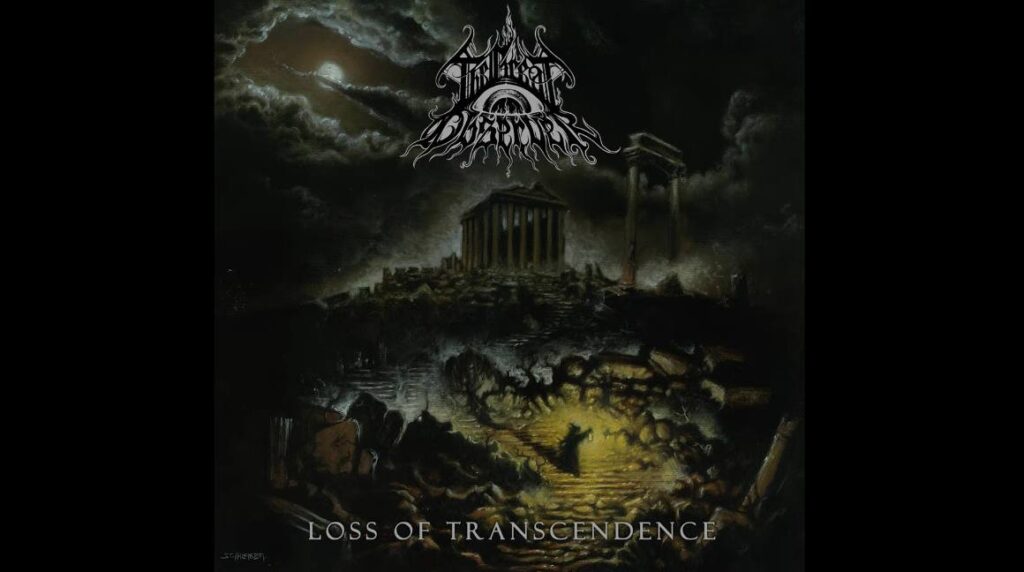
The production applied to “Loss of Transcendence” is properly occult but mostly clean for the black/death/thrash style. The band should not be seen as a simple throwback, because “modern” guitar techniques and atmosphere enter some tracks, mainly in the barbaric excursions of “The Great Observer” and the closing/title “Loss of Transcendence”. Also, the cover by bassist Claudio is excellent at conveying the theme, without easily pretending retro points with the rough graphic trends of the late 80s underground. Instead, it gives a whole world for the eye to wander through as you listen.
The only real complaint I have with this record is that its momentum rarely drops, offering little respite from the relentless heavy metal and punk galloping march. Perhaps it would be better if there were more than one or two short interludes.
“Loss of Transcendence” is a well-thought-out and highly stylized release that offers many headbanging anthemic moments within its rushing heavy metal step. The Great Observer’s loud, barking and riff-forward journey comes within an admirable tradition, as they try to grow the impact of early extreme metal in a bigger forum — songs to rally those who disagree, while they continue to raise their fists in the hall.
Otherwise, I’ll point out that the album will probably appeal to fans of 80s heavy metal as well as the early forms of extreme metal that still rely on the dynamics of thrash.