When gothic doom stops pretending to be darkness and starts inhabiting it
For fans of: Paradise Lost, Moonspell, Katatonia, Sentenced, Swallow the Sun, Draconian, but also those who seek gothic metal as an existential experience rather than an aesthetic pose.

Maurizio Dottore completes the four-part concept that began with Metamorphosis, Journey and Arrival, but Death doesn’t work as a mere epilogue. It’s more the moment when the journey stops having a destination and turns into a state of being. The river —the project’s central allegory— doesn’t simply flow into the sea. It gets lost inside it.
And that’s the album’s greatest success. It doesn’t try to impress with excess. It doesn’t chase the easy “dark”. It doesn’t dress in gothic aesthetics to hide musical weaknesses. Instead, it builds a heavy, melancholic atmosphere that feels honest. And that, in today’s gothic and doom scene, is rarer than it should be.
Death moves in a space where melodic gothic metal, doom, dark rock and cinematic orchestrations meet. The guitars stay heavy without being trapped in the logic of riff-for-the-sake-of-riff. The keys work underground, giving depth instead of easy symphonic grandeur, while the production leaves room for the compositions to breathe without sacrificing their power.
The album’s greatest virtue is its balance. It never becomes too doom to get bogged down, nor too gothic to end up theatrical. It constantly sits on a fine line between heaviness and melody.
“Oblivion” opens the door to this world in an almost hypnotic way. It doesn’t look for the big refrain from the first minute. It gradually builds a sense of loss, letting the melody work more like memory than a hook.
By contrast, “Endgame” is perhaps the album’s most aggressive moment. The guitars gain more weight, the tempos tighten and Diego Rapacchietti’s contribution is felt through drums that hit hard without ever overpowering the compositions. He doesn’t play to show how good he is. He plays to serve the song. And that’s the difference of a great drummer.
“Phoenix” works as the necessary breath. Not because it becomes brighter, but because it reminds us that even within absolute darkness there is the idea of rebirth. Here Black Reuss come closest to the European gothic tradition without sounding like a copy of Moonspell, Paradise Lost or Sentenced. The influences are there, but they don’t become a crutch.
“Elysium” completes the journey in an almost cinematic way. It doesn’t seek the impressive finale. It prefers to let the listener float in the silence that follows the last note. And that is perhaps the album’s strongest moment.
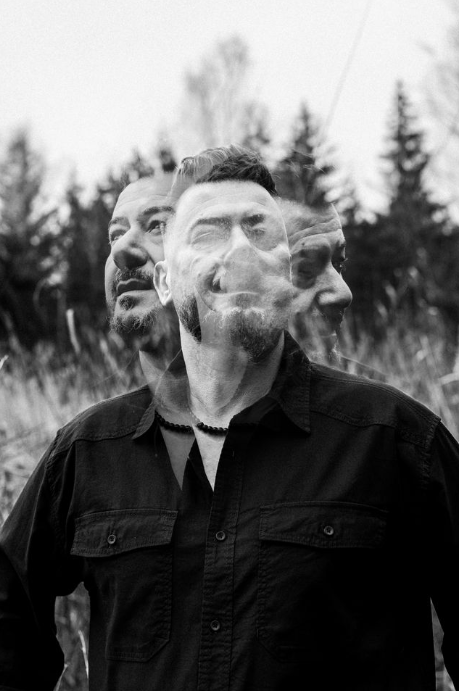
Maurizio Dottore has taken on almost everything: composition, performances, production and the overall artistic vision. The result doesn’t sound like a one-man project trying to prove something. It sounds like the work of a creator who knows exactly what he wants to say and, above all, what he doesn’t need to say.
The production by Roberto Macis and Giovanni Versari avoids the trap of excessive compression that plagues many modern metal releases. There is volume, but there is also air. The guitars have body, the vocals stay forward without drowning the whole and the drums retain a natural character.
The raw truth
Death is not an album for everyone.
Anyone expecting nonstop breakdowns, technical display or easy choruses that stick from the first listen will probably be disappointed. This album requires time. It requires mood. It requires you to sit with it when night falls.
And yes, at certain points the obsession with atmosphere limits the explosiveness. There are moments when you’d want a bigger climax or a bolder outburst. Black Reuss almost always choose restraint over explosion. For some, this will be a sign of maturity. For others, a missed opportunity.
But that is also the essence of the album.
It doesn’t shout.
It doesn’t extort emotion.
It doesn’t try to go viral.
At a time when much of modern metal production seems written for playlists and algorithms, Black Reuss release an album that feels almost anti-commercial. And that choice is admirable.
Conclusion
Death is the most mature and complete moment in Black Reuss’s path to date. An album that doesn’t use death as an aesthetic accessory, but as a philosophical starting point. Dark without becoming cliché. Melodic without losing weight. Doom without sinking into monotony. Gothic without turning into caricature.
It won’t change the map of gothic metal.
It doesn’t even try.
What it does is harder: it offers an album with personality, consistency and soul. And in the end, those are what remain when the noise dies down.
Rating: 8.8/10
For fans of: Paradise Lost, Moonspell, Katatonia, Sentenced, Swallow the Sun, Draconian, but also those who seek gothic metal as an existential experience rather than an aesthetic pose.
SΟCIAL MEDIA
Official Website: www.blackreuss.com
Facebook: www.facebook.com/blackreuss
Instagram: www.instagram.com/blackreussmusic/
Youtube Channel: www.youtube.com/channel/UC9UG6Rfa93ldqXiP3D6kVyA
TikTok: www.tiktok.com/@blackreuss